
 Oct 05, 2026
 69
69
 admin
admin
Choosing a safety mesh fence for a factory or warehouse involves more than selecting a panel height, color, or unit price. Start by identifying the hazard or area to be separated, then check mesh openings, fence construction, pedestrian and forklift routes, access gates, floor fixing, and applicable local requirements.
In this guide, “safety mesh fence” means a rigid barrier system made from metal posts and welded mesh panels. It can be used for machine or automation-cell guarding, internal warehouse partitioning, and equipment-area separation. It is not the same product as flexible rack safety netting, construction safety netting, or a road guardrail, and these products should not be treated as interchangeable.
Different areas call for different protection. Mark the proposed fence line, boundaries, access points, nearby equipment, and work routes before requesting a quotation.
Machines and automation cells: Enclose hazards around robots, conveyors, presses, or processing equipment. The fence position, openings, gates, and safety distances should be determined with the equipment supplier or a qualified safety professional based on a risk assessment.
Warehouse partitions: Separate picking, packing, equipment, restricted-access, or designated storage areas. Consider daily movement, visibility, cleaning, and future layout changes.
Equipment and inventory areas: Create controlled zones around electrical equipment, production assets, or selected goods. If the main concern is falling stock from elevated racks, assess rack-specific safety netting or load-stop systems rather than relying on a general partition fence.
Facility perimeter: Boundary security, gate management, and climb resistance may require a different system from internal machine guarding.
OSHA’s general industry machine-guarding rule requires safeguards for relevant machine hazards; the appropriate method depends on the hazard, and a fence is only one possible safeguarding method. See OSHA 29 CFR 1910.212.
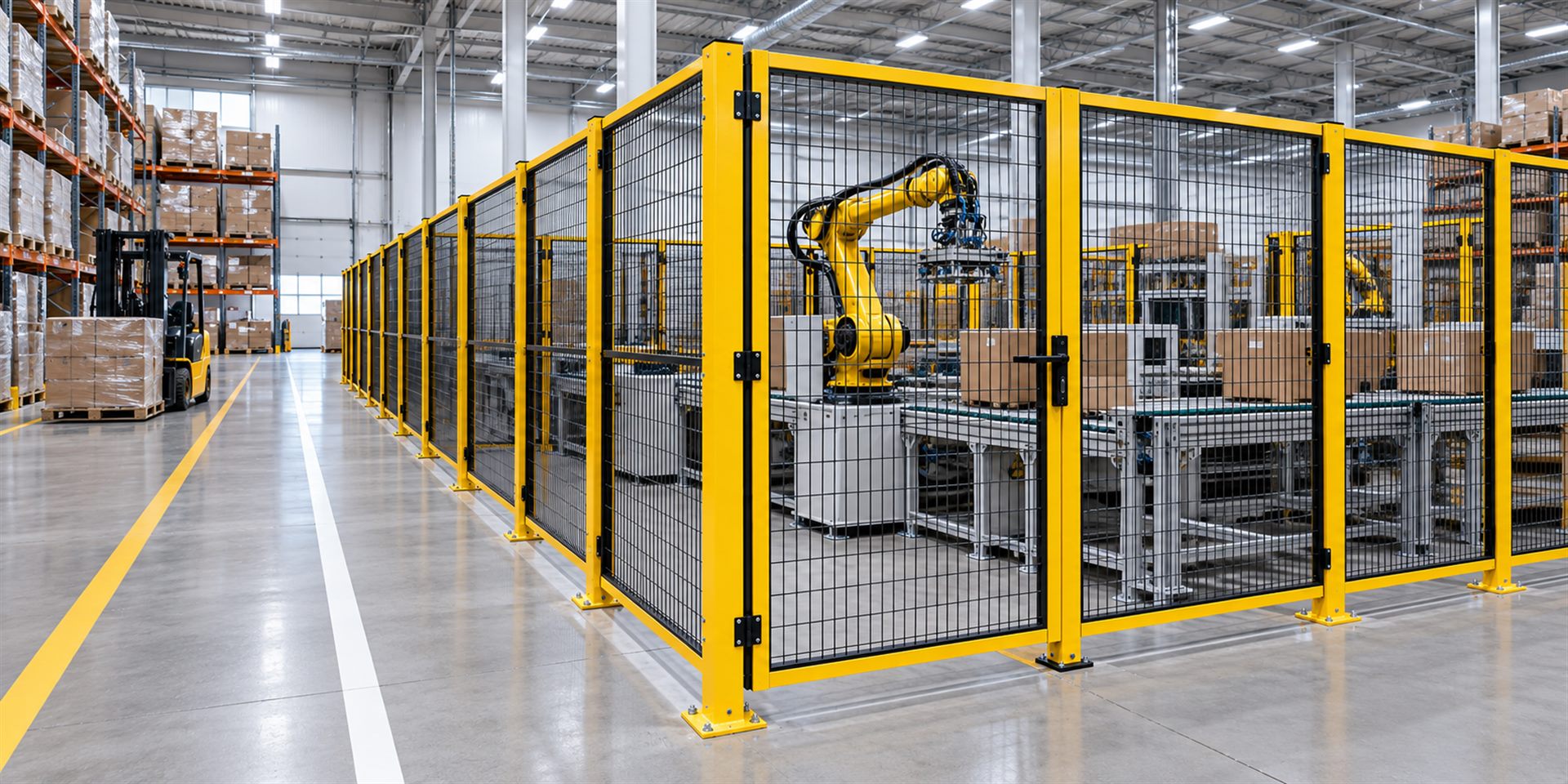
Mesh opening size, fence height, and the distance from the fence to a machine hazard should be assessed against potential reach, machine movement, ejected material, and worker activity. An opening that is too large may allow access to a danger zone. Making the mesh denser by itself does not prove that the complete machine installation is safe.
The UK Health and Safety Executive advises that openings in wire-mesh or similar guards should not allow access to moving dangerous parts. If a fixed guard is not practical, other measures, such as interlocking guards, may need to be considered. See the HSE introduction to machinery safety.
Do not choose an opening size from a generic catalogue alone. Give the supplier the equipment layout, hazard-zone boundary, required separation distance, and expected gate-use frequency. Ask for the panel and opening arrangement to be confirmed against project drawings. Purchasing a fence alone does not replace a full machine risk assessment, interlock design, or safety validation.
A typical rigid safety fence includes welded mesh panels, frames, posts, connectors, gates, and floor bases. Compare the wire diameter, mesh opening, panel dimensions, frame section, post specification, connection method, and anchoring details against the intended use and site conditions.
Choose surface protection with the environment in mind: indoor or outdoor exposure, humidity, cleaning methods, chemical contact, and maintenance access. Ask for details of the base material, coating or galvanizing, edge treatment, weld protection, and intended environment. Broad terms such as “rustproof” or “heavy-duty” are not a substitute for specifications.
Visibility is another design consideration. The mesh should provide the sightlines needed to monitor equipment and activity while meeting the risk-control requirements. If the area also presents risks from flying chips, liquid spray, dust, or noise, open mesh may not be enough. A qualified professional should assess whether solid panels, transparent guards, or a combined system is appropriate.
ISO 14120 sets out general requirements for the design, construction, and selection of fixed and movable machinery guards. Confirm which standards and legal requirements apply to the target market, machine type, and project.
Do not evaluate only the straight fence panels. Maintenance, replenishment, and cleaning may call for a single-leaf, double-leaf, or sliding gate. Confirm the clear opening width, swing direction, locking method, and emergency egress needs. Where workers regularly enter a machine hazard area, discuss interlocking and stopping logic with the equipment manufacturer or system integrator; an ordinary gate latch is not a safety interlock.
Warehouse drawings should also show pedestrian routes, forklift lanes, loading areas, fire routes, and picking locations. A gate should not swing into a primary aisle or conflict with racks, machinery, or other doors. OSHA’s materials-handling rule calls for safe clearances where mechanical handling equipment is used and for aisles to remain clear. See OSHA 29 CFR 1910.176.
If forklifts could strike the fence, separately verify the design of posts, bollards, or impact-protection equipment. A standard mesh partition should not automatically be treated as a vehicle-impact barrier.
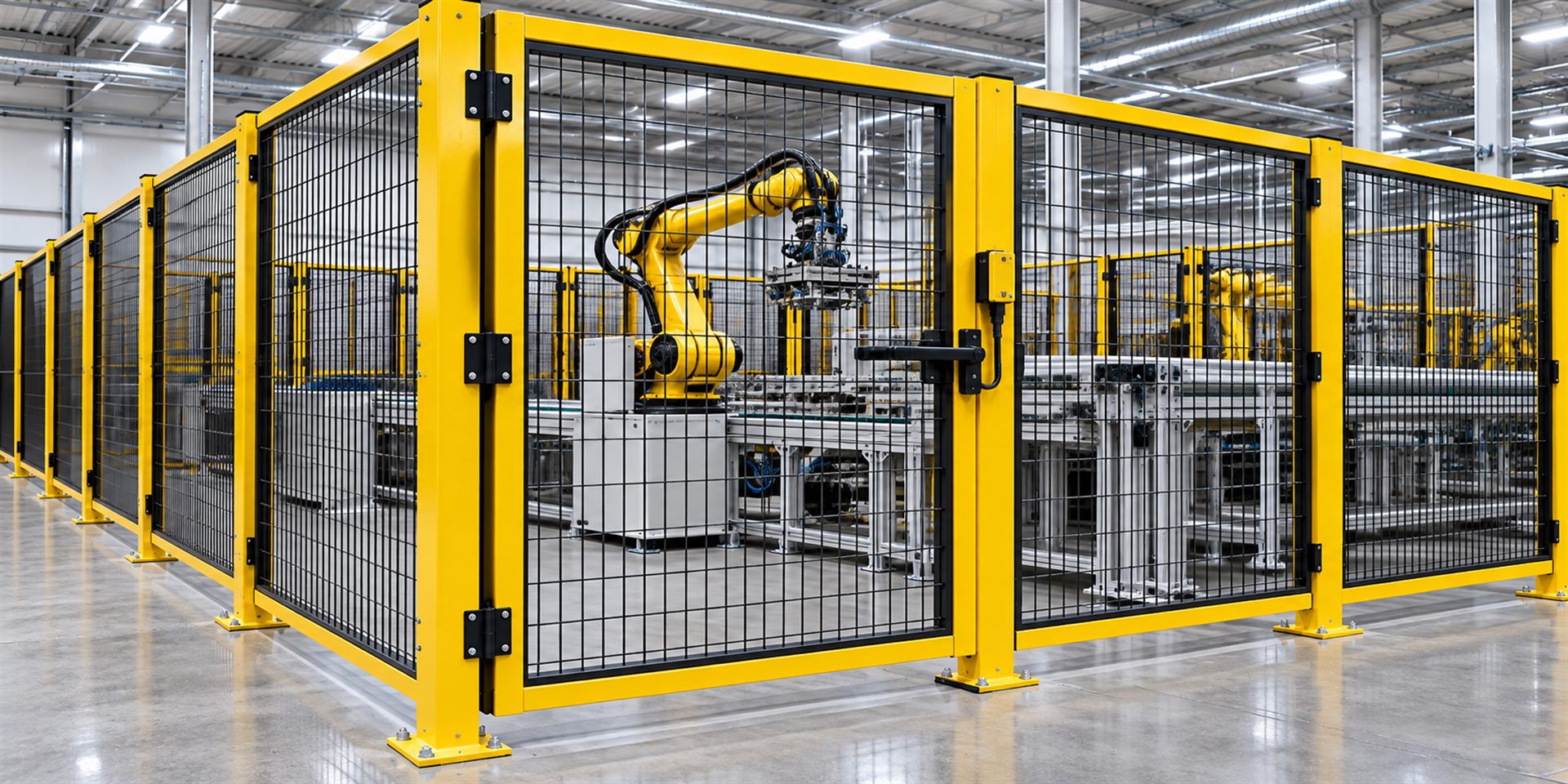
Use a floor plan to check fence runs, corners, end conditions, post spacing, gate openings, maintenance zones, and expansion interfaces. For irregular spaces, ask for a numbered panel layout or CAD drawing showing removable sections and service openings.
Confirm how the system will be fixed: floor material, slab thickness, anchors or cast-in inserts, base-plate locations, and any services that must be avoided. If the fence is to attach to existing equipment frames or racking, first verify that the supporting structure can take the added load; do not assume any existing structure is suitable.
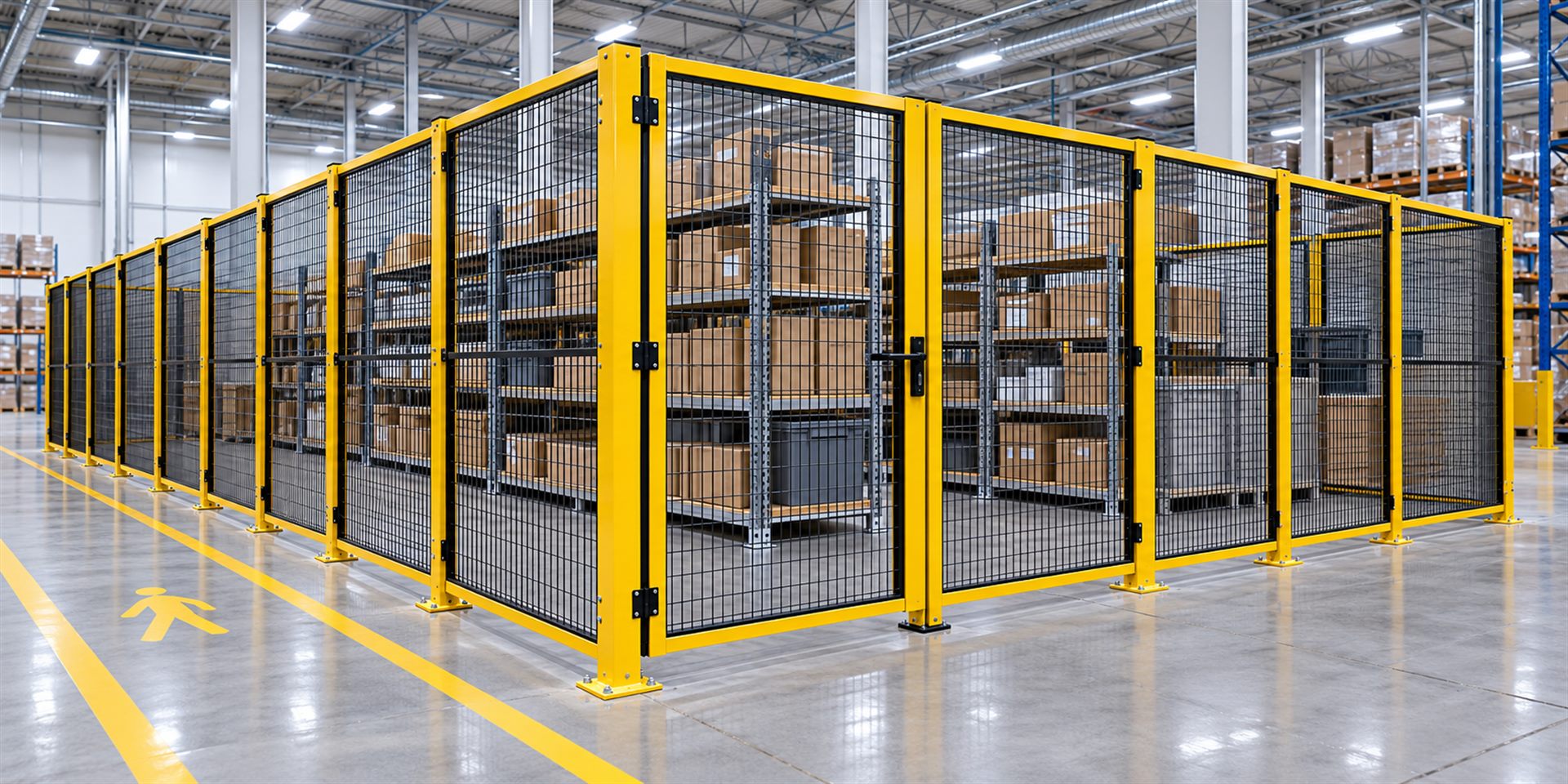
Use the same project brief for each supplier so quotations can be compared on a consistent scope. Request:
A floor plan, panel schedule, and gate-opening list
Wire, mesh, frame, post, and connector specifications
Base-plate, anchoring, and installation-interface details
Gate, latch, and, where applicable, interlock-interface requirements
Surface-finish information, packaging, supply scope, and warranty terms
Installation instructions and maintenance recommendations
For machine-guarding projects, include the fence supplier, equipment manufacturer, system integrator, and site safety lead in the design discussion. State in the technical agreement whether interlock switches, electrical controls, risk assessment, or on-site installation are included; do not assume they are part of the fence supply.
Before installation, confirm floor level, anchor positions, clearance from the equipment, gate swing, and aisle width. After installation, inspect panel connections, post fixing, sharp edges, gate latches, signs, and interlock function where applicable. Follow the site’s inspection process to identify loose fixings, deformation, corrosion, or unauthorized changes.
Modular panels can make a future production-line layout easier to change, but any revised arrangement must still meet the updated risk assessment and safety distances. Recheck the machine-guarding design after moving the fence or widening a gate; installation convenience alone is not a safety basis.
Choose a factory or warehouse safety mesh fence by starting with the hazard and the area to be protected. Then confirm mesh, frame, gates, layout, fixing, and surface finish against the site and applicable requirements. A sound purchasing process compares more than panel prices: it checks that the fence works with the equipment, pedestrian routes, forklift traffic, and local safety needs. Machine guarding, rack fall protection, and vehicle-impact protection each require the appropriate system.
They are commonly used to separate machinery or automation cells, control access to equipment areas, and partition work zones. The final configuration depends on the site risk assessment, equipment layout, and applicable requirements.
No. Opening size must be assessed with the hazard location, safety distance, reach, visibility, and work process. A smaller opening alone does not make a complete machine-guarding system safe.
Not necessarily. Assess rack-specific safety netting, load stops, or another engineered solution, including its load requirements and mounting location.
That depends on the hazard assessment, access frequency, and applicable regulations. The equipment manufacturer, system integrator, or qualified safety professional should confirm the access and stopping logic.
Share a site plan, intended fence use, equipment positions, pedestrian and forklift routes, gate requirements, floor construction, environmental conditions, and applicable standards. This helps suppliers prepare a more accurate layout and specification.
For a factory or warehouse mesh-fence discussion, prepare a floor plan, fence lengths, gate locations, site photos, and the intended protection application. Then confirm product specifications, supply scope, and installation interfaces.
WhatsApp: +86 189 2407 9286
Email: info@aotianhouse.com
Website: www.aotianguardrail.com
If you are interested in our products and want to know more details, please leave a message here, we will reply you as soon as possible.
If you are interested in our products and want to know more details, please leave a message here, we will reply you as soon as possible.