

 Oct 01, 2026
 50
50
 admin
admin
When a property needs to restrict vehicle access around an entrance, parking area, storefront, or pedestrian zone, bollards can help define the boundary. The key choice is not only the post's appearance or material. It is whether vehicles need to pass through that point at certain times.
As a starting point, consider fixed bollards where vehicle access is not required and removable bollards where authorized delivery, maintenance, or emergency access must be available occasionally. Some properties use both types in different locations.
Fixed bollards remain in position after installation and are used where vehicle access should be continuously restricted. Removable bollards fit into an in-ground sleeve or compatible base and can be unlocked and lifted out to open a controlled passage.
| Factor | Removable Bollards | Fixed Bollards |
|---|---|---|
| Vehicle access | Can open a passage when authorized | Usually cannot be moved after installation |
| Typical locations | Service entrances, delivery access, temporary closures | Building edges, pedestrian areas, permanent boundaries |
| Daily operation | Requires unlocking, removal, and secure storage | No routine operation |
| Installation checks | Sleeve, drainage, substrate, storage, and locking method | Foundation, anchoring, and underground utilities |
| Main selection factor | How often access is needed and who operates it | Whether the boundary should remain closed |
Installation method and performance depend on the product design and site conditions. The labels “fixed” and “removable” alone do not determine impact protection.
Consider removable bollards when an opening should normally be restricted but occasionally needs to admit approved vehicles. Common examples include:
Delivery or maintenance entrances with scheduled access
Parking areas with a controlled vehicle opening
Plazas or event spaces that open and close at different times
Access routes that must remain available under an approved emergency plan
Before selecting this type, define who unlocks and removes the post, where it will be stored, and who reinstalls it after access. An unclear operating routine can make the removable feature difficult to manage.
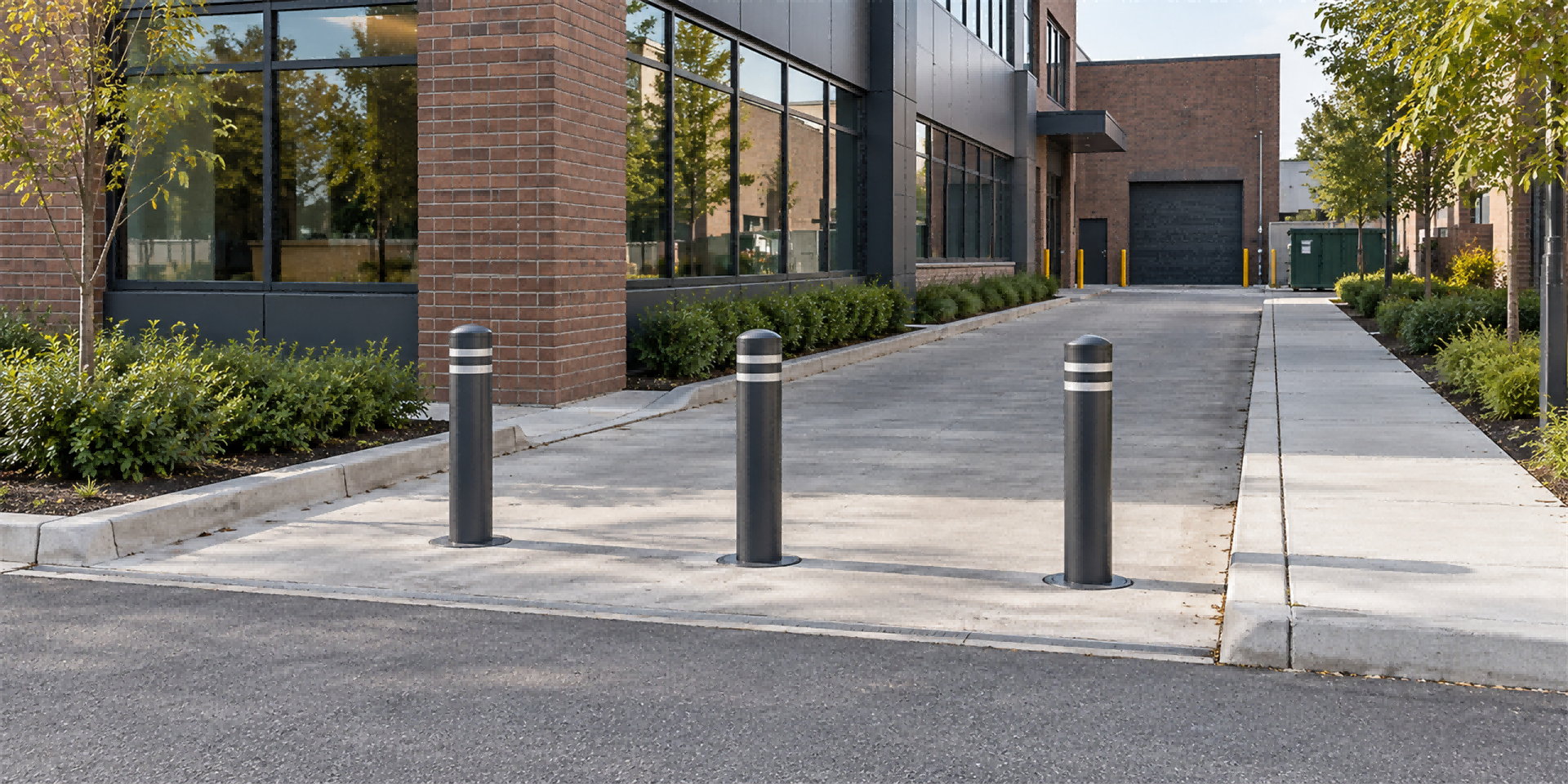
Fixed bollards are suited to boundaries where vehicle access is not expected, such as the edge of a pedestrian area, in front of a building facade, around equipment, or along a permanently restricted perimeter.
Because they do not require daily removal, fixed bollards are straightforward to operate. The trade-off is reduced flexibility: if a delivery route or service entrance may be needed later, the access layout should be planned before installation.
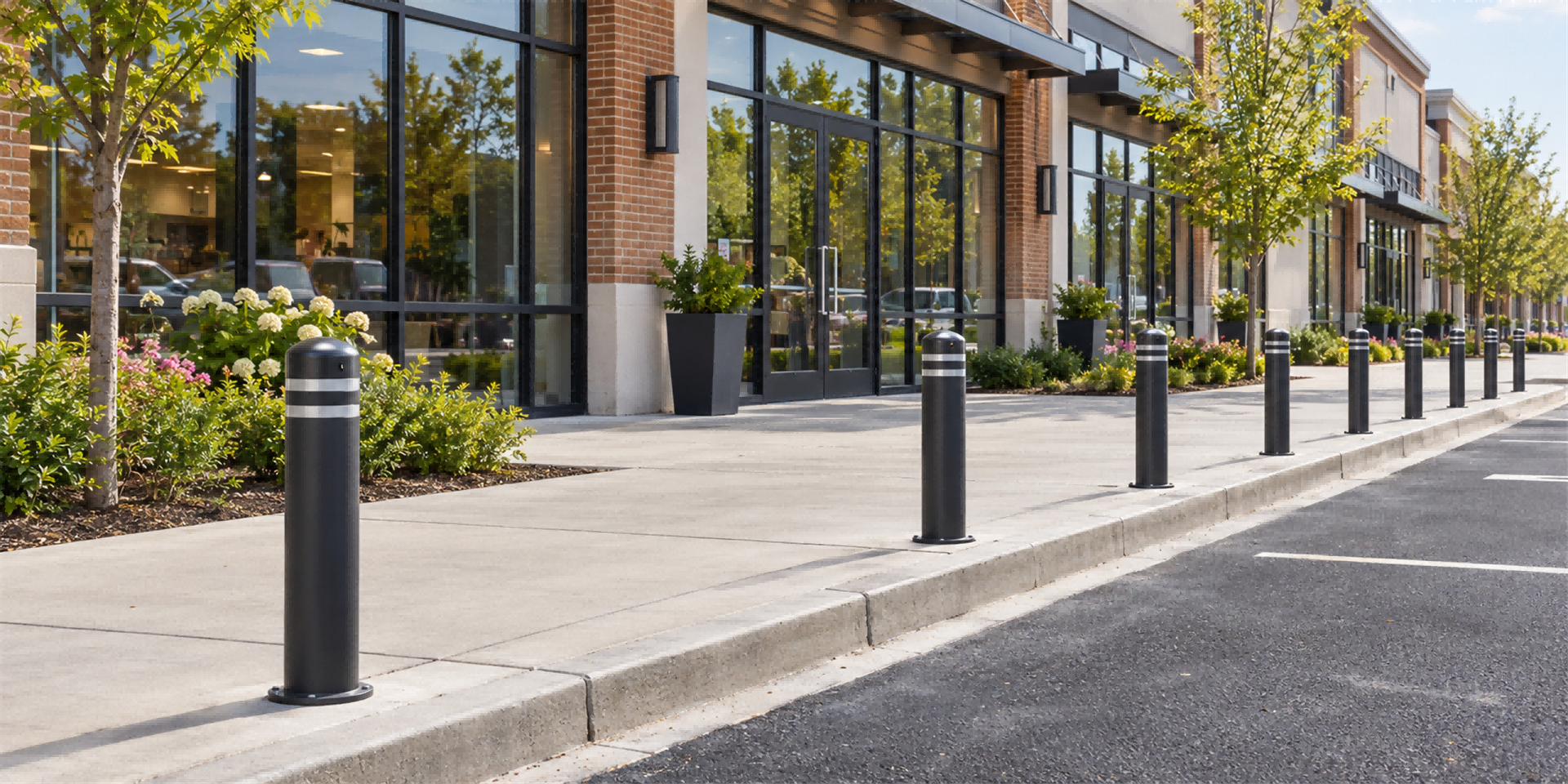
Not necessarily. A fixed bollard is not automatically crash-rated, and a removable bollard is not automatically intended only for low-risk use. Protection depends on the specific post, locking arrangement, foundation, installation quality, and supporting test documentation.
For projects requiring vehicle-impact protection, review reports for the complete system and configuration. ASTM F3016/F3016M provides a test method for vehicle impact protective devices at low speeds, while ASTM F2656/F2656M addresses crash testing of vehicle security barriers. A rating should be interpreted for the tested conditions; it is not a guarantee of identical performance with a different foundation, installation, or impact approach. ASTM F3016/F3016M · ASTM F2656/F2656M
Bollard placement should also preserve pedestrian circulation and accessible routes. The U.S. Access Board notes that security bollards at accessible entrances must not obstruct accessible routes or accessible means of egress. Check the requirements that apply in the project's jurisdiction. U.S. Access Board guidance on entrances and security barriers
Before ordering, confirm the following site details:
The opening width, vehicle path, and turning movements.
The surface construction and its suitability for the chosen anchoring or sleeve system.
Underground utilities, drainage, and the risk of water or debris collecting in a sleeve.
Bollard spacing in relation to both vehicle restriction and pedestrian access.
For removable units, the unlocking, storage, and reinstatement procedure.
Any required impact performance and whether test documentation matches the specified configuration.
Yes. A property can use fixed bollards along boundaries that should remain closed and removable bollards at designated delivery or service entrances. This can provide continuous separation across most of the site while retaining a controlled vehicle opening where needed.
Plan the layout as a system: determine the opening location and width, define who manages it, and maintain pedestrian and accessible routes. Avoid adding a removable opening only after the fixed bollards have already been installed.
Fixed bollards suit boundaries that should remain closed to vehicles. Removable bollards suit controlled openings that need to be used occasionally. Where impact protection is a project requirement, base the decision on product-specific test documentation, foundation design, and actual site conditions—not the bollard type or appearance alone.
1. Is a locked removable bollard as secure as a fixed bollard?
It depends on the post, locking system, sleeve, foundation, and test evidence. Being locked in place does not by itself establish a particular impact rating.
2. Are fixed bollards always more impact-resistant?
No. Impact performance is specific to the product and installation configuration. Check the test documentation against the project's requirements.
3. Are removable bollards suitable for emergency or maintenance access?
They may be appropriate when an opening must be controlled and occasionally cleared. Confirm local requirements, operating procedures, and responsibility for keeping the route available.
4. Can both types be used at one property?
Yes. Fixed bollards can define permanent boundaries, while removable units can serve designated delivery or service openings.
5. What information should I provide when requesting a quotation?
Share the location, opening dimensions, surface construction, vehicle types, access frequency, required impact performance, and applicable local requirements.
SANTIAN supports discussions for road-safety and property access-protection projects. Share site photos, opening dimensions, vehicle access frequency, and protection requirements to help assess a suitable bollard arrangement.
WhatsApp: +86 189 2407 9286
Email: info@aotianhouse.com
Website: www.aotianguardrail.com
If you are interested in our products and want to know more details, please leave a message here, we will reply you as soon as possible.
If you are interested in our products and want to know more details, please leave a message here, we will reply you as soon as possible.